
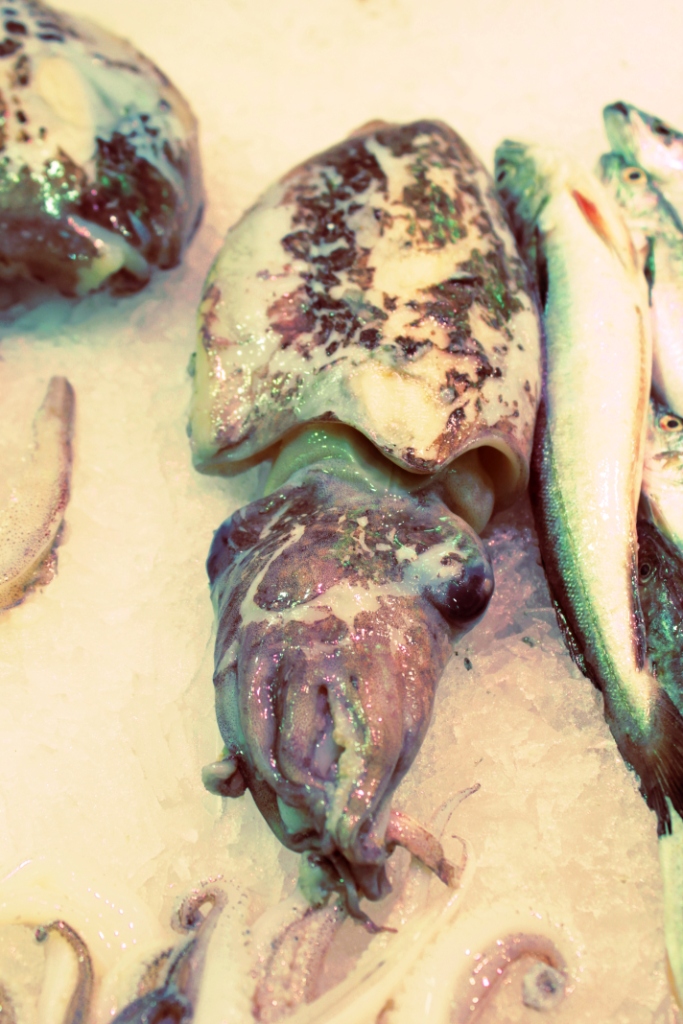
Fresh cuttlefish pre-cleaning
One of Oscar’s favourite mixes for stuffing into a brunch roll or ooping onto great crusty lumps of bread is this cuttlefish, tomato and pebrella mix. This last is a herb found locally. Its grown-up name is Thymus Piperella, and if you search online, you might find a supplier – it has a really distinctive flavour, and although oregano could be used as an alternative, it hasn’t got the same special kick.
For the fishy part, I dragged Iaia along to the Valencia markets yesterday to help me choose the best critters and then she walked me through the recipe step by step. It’s best to buy fresh (oh-so-ugly) cuttlefish and get your friendly fishmonger to do all the cleaning for you. You will probably still have to cut off the tough wings and pull out a beak or two, but the worst part will have been dealt with by abler hands (than mine, at least). Oh, and stand back when you put the cuttlefish into the pan – it spits!
What you need: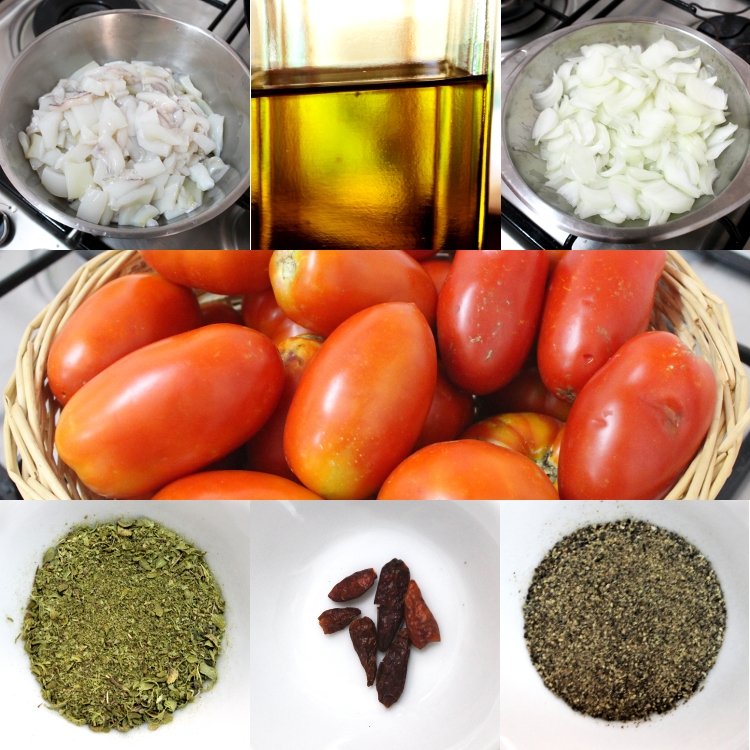
3 medium-sized cuttlefish
a healthy kilo of pear tomatoes
2 onions
olive oil
black pepper
pebrella (thymus piperella)
dried chillies
What you do:
Chop the onions and cuttlefish into smallish pieces. Grate the tomato and put some oil in a deep pan to heat. The cuttlefish is the first to go in as it takes quite a while to cook. It spits horribly when it hits the oil, so be really careful! Let it sizzle gently for about 15 minutes before adding the onion to fry and soften for another 10 minutes or so.  Pour in the tomato, add some salt, the herbs and the chillies (Iaia uses a tea strainer to be able to fish them out before it gets too hot) and let everything bubble away quietly for about an hour, or until you see the tomato losing most of its wateriness and becoming thick – like a really great pasta sauce. Remember to test for flavour and remove the chillies when you notice a bit of heat.
Take off the heat and allow it to cool completely before serving. We like to leave it overnight and put spoonfuls into a crusty roll for brunch.
 Serve with: Cold white wine and lots of bread.
 Iaia's kitchen
Lisa, la “salsa” de la sèpia la fas servir? Una altra qüestió és el temps per fregir la sèpia. Hi ha peixateres que em diuen que cal tenir-la màxim dos minuts. Altres que fan com tu, més d’un quart d’hora.
LikeLike
Hello, I’m going to answer in English if that’s OK! For this dish we don’t use the cuttlefish ink. The fishmonger completely cleaned them all for me. As for cooking time – well, it depends on the type of dish. Like with squid, you have to either flash fry or long slow cook – anything in between gets rubbery and tough. So for “sepia a la planxa” I would cook it very quickly with a little oil, garlic and parsley over the top. For these tomato-based dishes you need to cook everything for long enough to soften the fish and for the flavours to develop.
Salut!
LikeLike
Lisa, when I said “salsa” I didn’t mean the ink, but that little bag with a brown fluid inside. I think is part of the digestive system of the cuttlefish and the liquid is semi digested food. I use it when I cook “arròs caldós de peix.” It is very tasty.
LikeLike
Ah! Well then, no we don’t use it for this, but I’d love to try your recipe for the rice!
LikeLike
To put here my recipe is like running against Alonso in a Seat 600. Nevertheless, here you are, Lisa.
Arròs caldós de peix
½ onion
2 ripe tomatoes
½ green pepper
A cuttlefish
2 or 3 red shrimps pro head
½ litre fish soup pro head
75 g rice pro head
250 g rosellones (little clams)
Normally I prepare huge amounts of fish soup that I freeze. The soup is made of assorted fish, most of them “de roca”, with “galeras” and crabs, an onion and a laurel leaf.
Boil the clams till they open. Those that remain closed, discard them.
Grate the tomatoes; cut the onion and the pepper in little chunks and fry with olive oil (I use Virgen Extra de Arbequina) in a cast iron cauldron. When the onion becomes transparent, cut the bag with the “salsa” from the cuttlefish and mix it. Add the cuttlefish that previously you have cut into square pieces. After a couple of minutes you pour in the rice, salt and saffron. Move for 15 or 30 seconds, just to let the rice catch the colour. Pour in the fish soup, at boiling temperature. You can add the shrimps now or after 10 minutes. After 15 minutes (more or less), put out the fire, add the rossellones (with or without shell) put the lid on the cauldron and leave it for 5 minutes.
The amount of soup depends on how “caldós” you like it. In winter I advice to serve it in heated plates.
I buy frozen red shrimps, which probably iaia will regard it as a blasphemy. My children, however, like them very much. The fish monger tried to convince me that they come from Huelva, but actually they are caught in southern east Atlantic, which probably means Namibia, and frozen in the ship. In Huelva there is the factory, where they pack them in boxes that read visibly “Tres carabelas, Palos de Moguer, Huelva.”
You can also add mussels, but I’m not very fond of them.
LikeLike
Sounds delicious Mario, I’ll try it next week some time – I’m sure Iaia will love it too!
LikeLike
Hi,
This sounds delicious! I was just in Venice and tried Spaghetti al Nero di Seppia. It is a spaghetti made with cuttlefish, and the sauce is made from it’s ink. The look is a bit horrifying but it is sooo good. I just posted about it. I seriously can’t get enough of the stuff. If you are a cuttlefish fan you should check it out.
LikeLike
Thanks for your comment! We also have a rice dish here called “arroz negro”. It uses squid ink and presents an odd looking black plate but is very tasty indeed. Unfortunately I can’t access your blog for some reason, so haven’t been able to read about your Spaghetti experience.
LikeLike
I’m always afraid of preparing squid or sepia “a la plancha” because it usually gets tough. I’ll try to make it that way you suggest, Lisa, quick cooking.
Hope you don’t mind if I copy your recipe, Mario, now that you’ve made it public.
LikeLike